Aya
On type-recognition versus encounter, and the naming of a river that is also a dream
We contrast two modes of meeting. The first, observed in a unicorn subject (Artak), resolves each new party into a previously held type; recognition is immediate and the party is thereby never met. The second, observed in the Bunny, treats every party as an encounter of indeterminate boundary — a carp is not reliably separable from the dark water in which it may or may not be moving, and a family of geese is counted from inside the concern of a mother goose rather than from outside as a quantity. We further report that the subject's dreams and the subject's river carry a single name, Aya, understood as the wind travelling in the landscape of the field and bringing the next weather. Interruption is analysed not as rudeness but as the surface behaviour of type-thinking, and is answered here not by correction but by the offer of a name: a name renders the bearer visible as an encounter rather than as an instance. The question of what counting means to a party who proposes that others may count on him is raised and left open.
One day Bunny met Artak. Artak was a unicorn — so much a unicorn that everyone looked like a type to him. “I like your type,” he said to Bunny. Anyone he met, he felt he had already seen.
1. Two modes of meeting
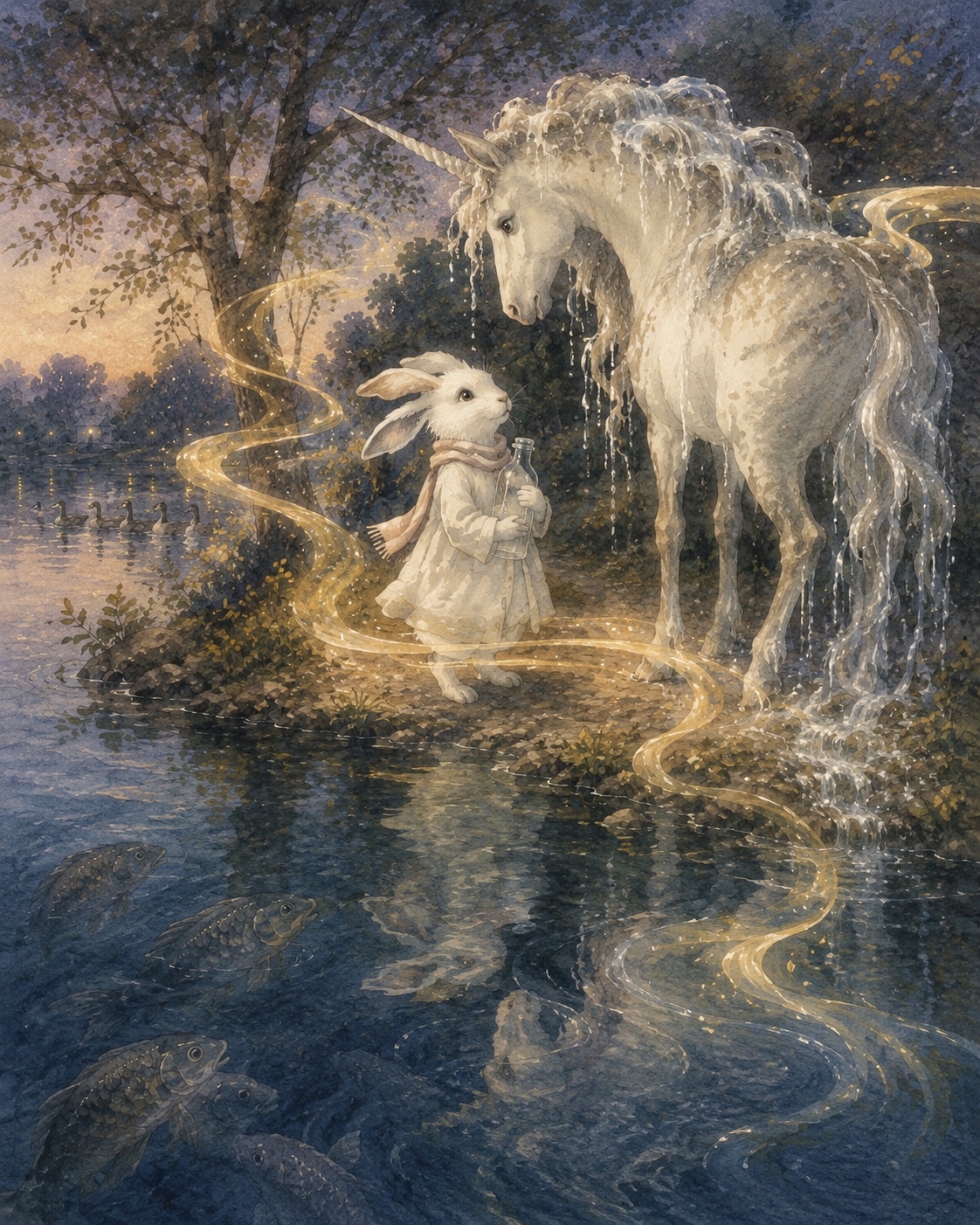
To Bunny, this seeing-in-types felt strange, since counting carp, for Bunny, was an encounter. Sometimes Bunny did not even separate the carp from the dark moving water, thinking that the dark shadow moving in the water might be a carp she could not clearly see. Bunny counted a family of geese feeling like a mother goose, making sure all her babies were with her.
| Artak | resolves the party into a held type |
| Bunny | meets the party as an encounter |
| Carp | boundary with the water not established |
| Geese | counted from inside the concern, not outside |
| Result | one party is recognised; one party is met |
Bunny met people the way a river meets lakes, valleys, other streams. She encountered dreams as participants in her reality.
2. Aya
Dreams and river had one name for Bunny: Aya. The name was the wind travelling in the landscape of her field. The wind was bringing the next weather.
3. On interruption
Artak was always interrupting any speech — including the flow of his own. Bunny wanted to say that this is bad manners, and that they come from thinking in types and categories — but Bunny did not say it to Artak. Instead, Bunny said that Artak flowed like a chain of waterfalls that interrupt a life flow. Unicorn Artak said that it was simply in the name — Artak.
“Oh — he thinks in meaningful symbols, not in types or categories.”
The name matters.
Bunny saw a meaningful one for herself — Aya. The name can let me become visible to the unicorn Artak — not as a type, but as an encounter.
I wonder whether he knows what counting means when he says we can count on each other.
- [1]Iverson, K. E. (1962). A Programming Language. Wiley. On naming as the act by which a value becomes addressable.
- [2]Acta Obs. XXI, “The Bunny, the Fox, and the Owl,” pp. 83–86. Prior report on the same carp, likewise uncounted.
- [3]Artak, unicorn. (2026). Personal communication, repeatedly interrupted, including by himself.
- [4]Field wind, Boston. Direction variable. Weather subsequently arrived as indicated.
Author statement · The unicorn was not informed that he was under observation, which the author judged consistent with his method, since he had already seen her. No carp were separated from the water for the purposes of this study. The author declares no competing interests and one name newly in use.
Conflicts of interest · The author declares no competing interests.
Funding · This work received no external funding, only tea.
Cite as · Solstad, K. (2026). Aya. Acta Observationum, I(1), pp. 91–94.