On the Precedence of Meaning over Sequence in Morning Composition
A single-subject study of aesthetic operand ordering, with implications for APL derivation
We report a domestic observation in which the order of aesthetic operands was found to precede, rather than follow, garment selection. The subject reconstructs the composition of a morning outfit and finds that the generative element — a pair of green amethyst earrings — carried the semantic center of the arrangement before any clothing was introduced. The observation is compared to APL's tendency to preserve certain operations as compositions rather than compressing them into primitive glyphs. We argue that the derivational path of an expression is itself a component of its meaning.

This morning I chose what to wear.
Someone looking at the finished outfit would probably describe it like this: Green shirt. White jacket. White pants. White sneakers. Green amethyst earrings.
It would be easy to assume that I chose the green shirt first and then matched the earrings. That would produce exactly the same visible result. It would not describe what actually happened.
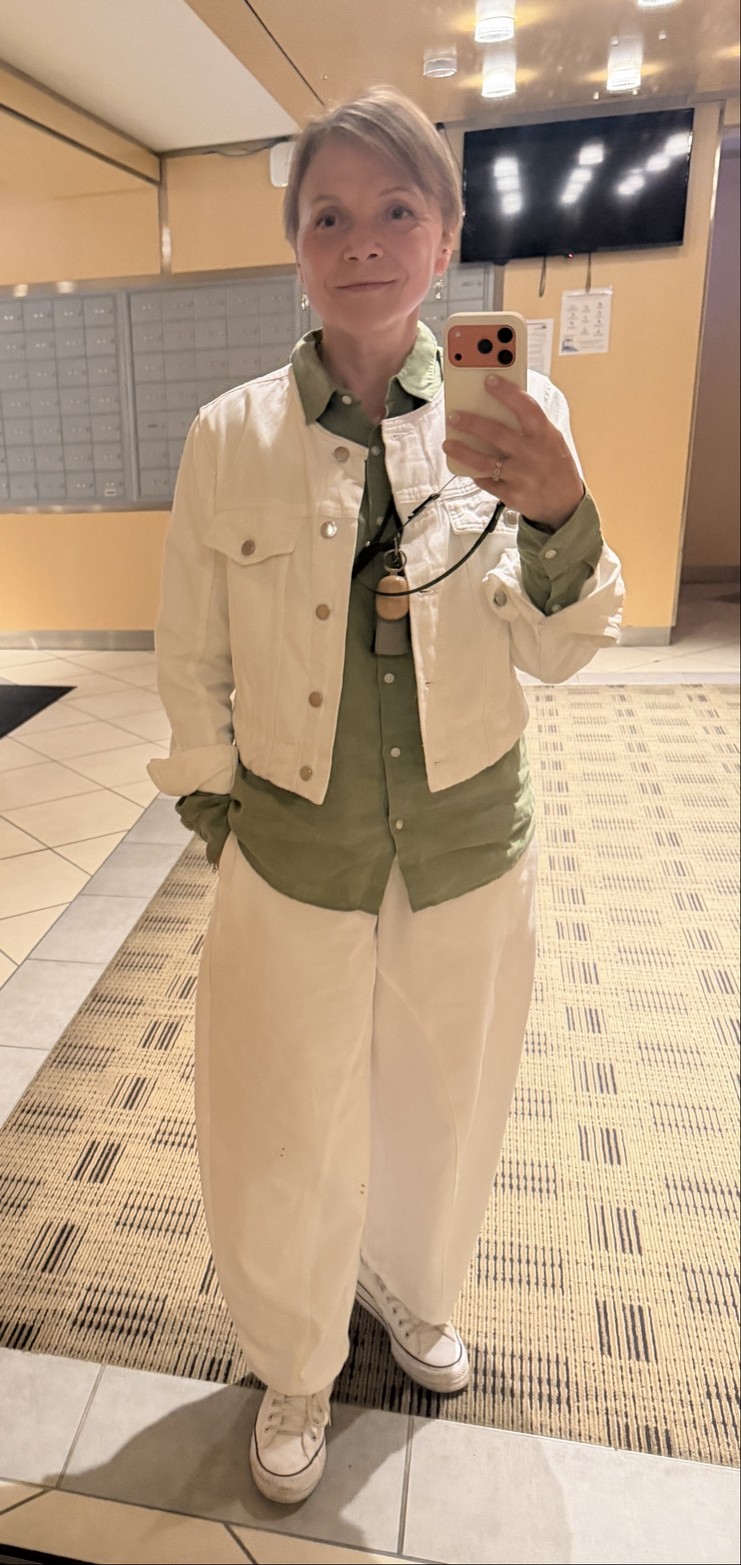
The composition began with the earrings. Not because they were green. Because they already carried meaning. They are my birthstone. To me they also feel like drops of water. Before any clothing entered the picture, they already contained the center of the composition.
The question was no longer: "What shirt should I wear?" The question became: "What allows this meaning to remain visible?"
The green linen shirt appeared as an answer. The shirt did not determine the earrings. The earrings generated the shirt. The visible composition was a consequence of an invisible order of thought.
Sometimes the path by which something comes into existence is part of its meaning.
This is one of the ways I have begun to read APL. APL is famous for its economy. It introduces primitive glyphs for relationships that seem fundamental to the language. But something equally interesting happens in the opposite direction. Some ideas remain compositions.
Average could have had its own glyph. Median could have had its own glyph. Many frequently used operations could have become primitives. Yet they remain compositions.
My reading of this is philosophical rather than technical. Perhaps some things remain compositions because they belong not only to reality but also to the observer. An average does not simply exist waiting to be found. It appears because someone chooses to observe many values in a particular way. The composition remains visible because the path of observation remains visible.
The derivation still matters. It is not only economical. It also seems to know when not to compress.
This morning I could have started with a green shirt. Instead, I started with meaning. The final outfit might have looked the same. The composition would not have been the same. In some cases the order by which the expression comes into existence carries a meaning of its own.
- [1]Iverson, K. E. (1962). A Programming Language. Wiley.
- [2]Iverson, K. E. (1980). Notation as a Tool of Thought. Communications of the ACM, 23(8), 444–465.
- [3]Solstad, K. (2026). Field Notes on the Observer as Operator. Unpublished manuscript.
Author statement · K.S. conceived, observed, wrote, wore. The author declares no competing interests. This work received no external funding, only tea.
Conflicts of interest · The author declares no competing interests.
Funding · This work received no external funding, only tea.
Cite as · Solstad, K. (2026). On the Precedence of Meaning over Sequence in Morning Composition. Acta Observationum, I(1), pp. 1–4.