Teaching Begins Where Borrowed Thinking Ends
A note occasioned by aplwiki.com/wiki/Mnemonics
We record an encounter with a wiki page pairing APL glyphs with visual mnemonics, and reflect on an earlier attempt to teach Python to a fourteen-year-old for whom no existing Wordle solution was accessible. We propose that a teacher's task is not the transmission of borrowed answers but the construction, in the relationship, of a language neither party could have produced alone.
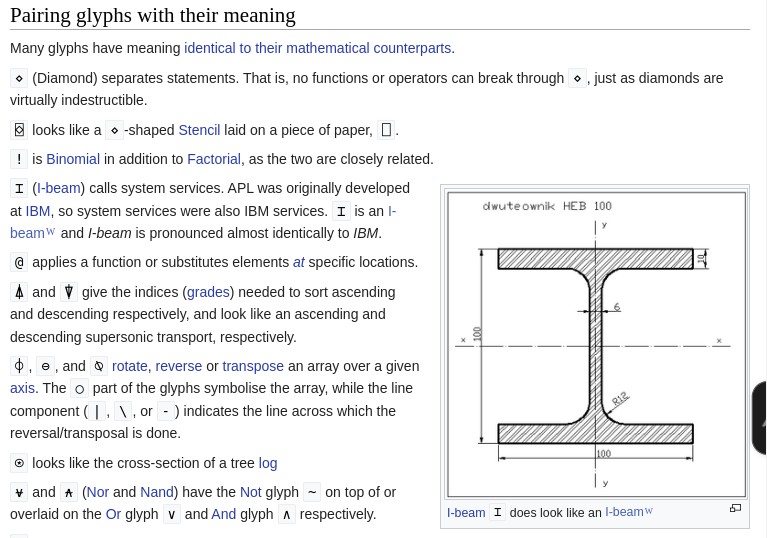
Pairing glyphs with their meaning
Many APL glyphs have meaning identical to their mathematical counterparts. Others are held together only by resemblance: ⋄ separates statements, as diamonds are virtually indestructible; ⎕ looks like a stencil laid on paper; ⍟ resembles the cross-section of a tree log; ⍱ and ⍲ carry Not (~) laid over Or (∨) and And (∧).
Teaching looks like the transmission of knowledge. A field already exists. A language already exists. A notation already exists. The teacher's task is to introduce the student to what the field already knows.
Some years ago I was helping a fourteen-year-old student learn Python. He loved the game Wordle, so I searched for programs that solved it. There were many. Some were elegant. Some were sophisticated. They all belonged to experienced programmers.
My student could not enter them. I had difficulty entering some of them, too.
My student did not lack intelligence. At times I thought this young man was more capable than me. The existing ways of holding the Wordle game simply could not enter the relationship that existed between this student and me, specifically.
The only place I could go was my own internal landmarks. I had to connect them. Only my own thinking could build the bridge. What truly surprised me was that I was capable of more than I knew. I approached words in colors — colors and design were always our common language.
Years later I encountered a simple wiki-page about APL glyphs. It contained almost no explanation. Only glyphs and a few words describing resemblances to things from reality.
The page did not teach me APL. It shared a way of seeing.
APL was totally new to me and I assumed that every APL programmer saw glyphs this way. I did not even bother to look at the name; I treated it as general knowledge of all APLers.
Collective mind is listening to the field of Kenneth Iverson and finding the authentic language to encounter him.
When I look at Kenneth Iverson, I wonder if an existing language could not carry the true sharing with students.
New language is not born from abstraction. Language has a source in relationships inside reality.
Yes, the meaning of teaching is transformed — and many pieces that puzzled me before about Iverson and his lifelong path with notation as a tool for thought found their places.
Our authentic thinking remains invisible until another consciousness asks a question that no borrowed answer can satisfy.
This hypothesis cannot be proved. It only can be lived.
- [1]aplwiki.com/wiki/Mnemonics (accessed June 2026).
- [2]Iverson, K. E. (1980). Notation as a Tool of Thought.
- [3]Papert, S. (1980). Mindstorms. Basic Books.
Conflicts of interest · The author declares no competing interests.
Funding · This work received no external funding, only tea.
Cite as · Solstad, K. (2026). Teaching Begins Where Borrowed Thinking Ends. Acta Observationum, I(1), pp. 23–25.