Encounting
A sincere method for the enumeration of carp, in which the unit is the mutual encounter and the fraction is divided attention
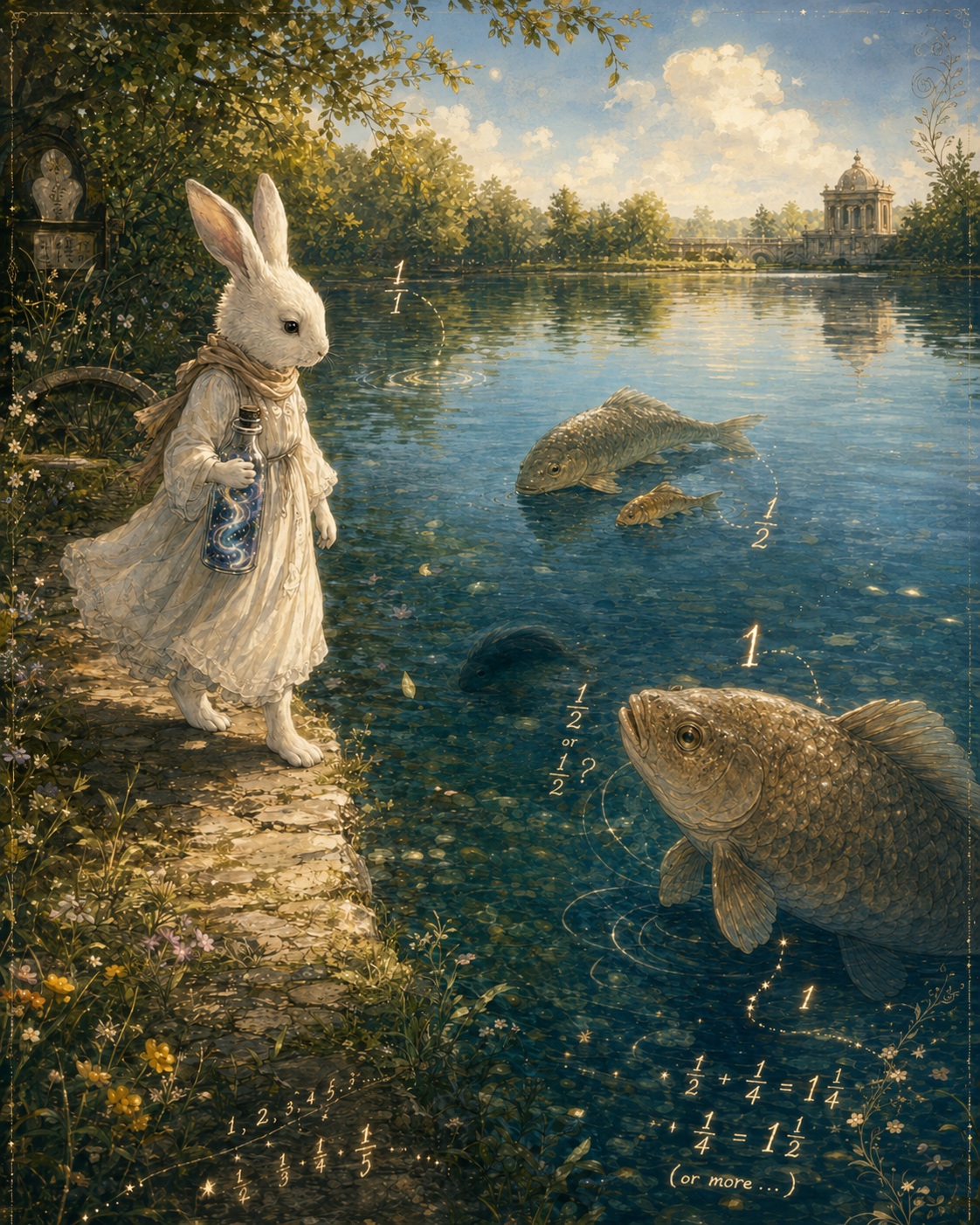
A method of enumeration is proposed and tested in the field on the population of carp visible from the shore of a reservoir. The method departs from ordinary counting in that the unit is not the object but the encounter: a carp seen by the observer without seeing her is not a whole. Under the method, unity is reserved for mutual recognition, and all other sightings are expressed as the observer's single attention divided among the candidates receiving it. Two structurally distinct sources of the value 1/2 are distinguished — division by two carps, and division by two options as to whether a carp is present at all — and the identity of their numerical form is reported as a defect of ordinary notation rather than of the observation. An unresolved dark spot is shown to be dynamic: its value falls as further carp are recognised, so that its significance is inversely proportional to the richness of the field. The limiting case is noted and is the principal result: on days when no carp is seen, the unseen carp attains its maximum value. Two plates are entered as Figs. 24 and 25.
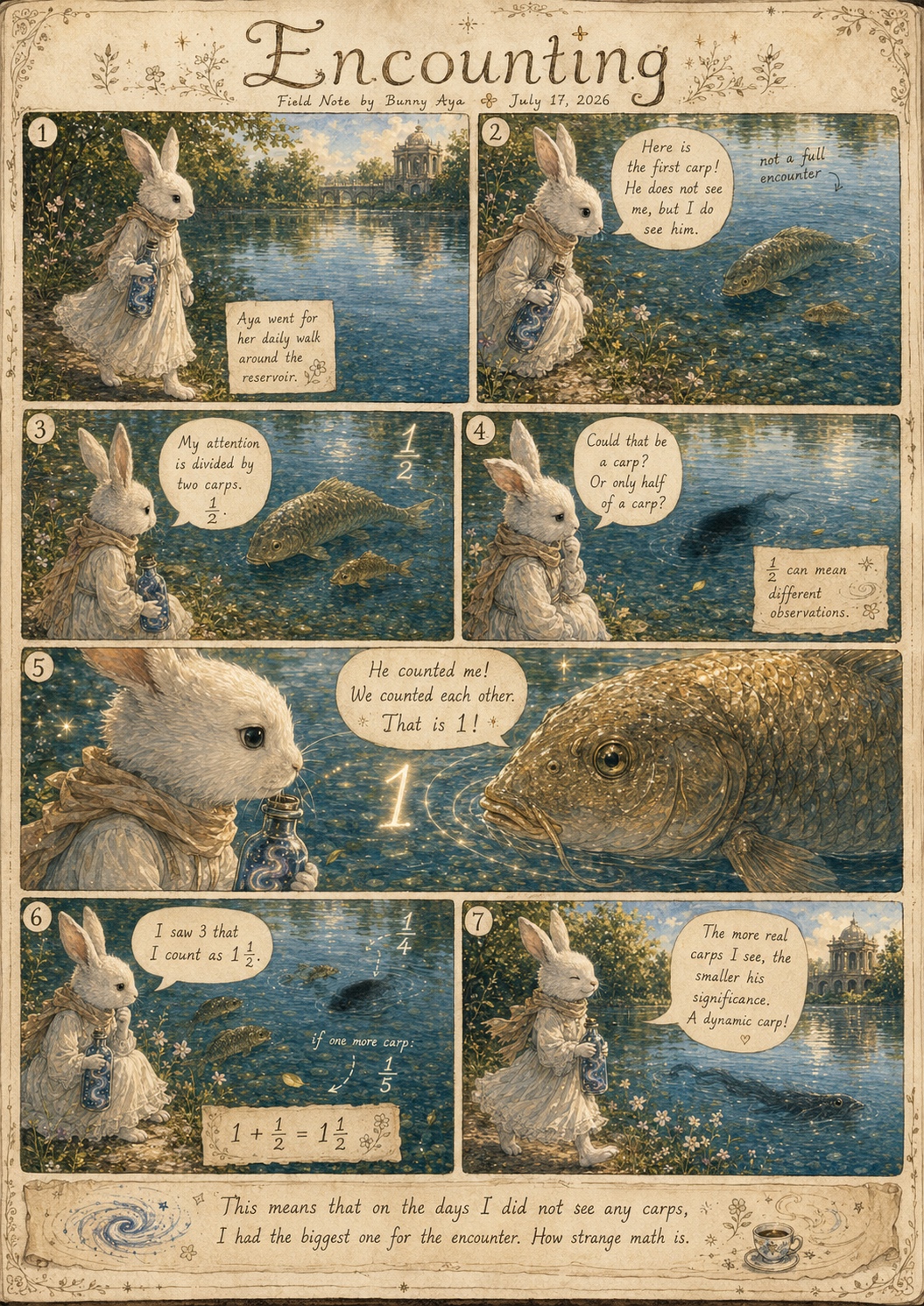
Aya went for her daily walk around the reservoir. She calls it carp counting, even when she would not see any. Aya went in any weather, but carps only liked a warm clear day for being visible from the shore.
Aya walked by the water, looking into the wet field. It was a sunny and warm day, July 17, 2026.
1. The incomplete sighting
“Here is the first carp! He does not see me, but I do see him. It is not really a full encounter — it is just me looking at him. I am not sure how to count him in my sincere way.”
2. Division by two carps
And then she saw a little one right next to the big one. The little one only looked at the parent, trying not to get lost in the waters of the reservoir.
“Here are two of them. I see them. My attention is divided by two carps that do not see me. I think I can count them as one divided by my attention for two — 1/2. Yes. This is a good count.”
3. Division by two options
Aya kept walking. A dark spot in the water was moving in the deep. Could that be a carp? Or only half of a carp?
“What if it is also 1/2 — but not because I am looking at two carps? What if it is because I am not sure what I am looking at, and I have two options? My attention is divided by two options, not by two carps.”
Mathematics was becoming very obscure, thought Aya.
“1/2 can mean totally different observations. Okay. I will decide later how I am going to count that moving water.”
| Seen, not seeing | not a full encounter; value withheld |
| Two carps, neither seeing | 1/2 — attention divided by two carps |
| One uncertain shape | 1/2 — attention divided by two options |
| Identical notation | structurally different observations |
| Mutual look | 1 — the whole unit |
4. The unit established
And Aya kept walking. Suddenly she saw a big old carp, looking so wise that Aya thought he must be a mathematician of the reservoir. The carp mathematician looked right at her.
“He counted me! We counted each other. That is a real encounter! That is 1!”
“Yes. I have one whole encounter, and that 1/2 from seeing a parent with a child in the distance. This is clearly 1 1/2. In total, I saw 3 that I count as 1 1/2, but I did see three real ones and one dark spot moving. I did pay attention to all 4.”
5. The dynamic carp
“My one attention could be divided by everything I saw as carp or possible carp. I think that dark moving spot is 1/4. But if I see one more carp, that moving spot would be 1/5.”
The moving spot kept moving with her walk.
“The more real carps I see, the smaller his significance. A dynamic carp!”
Aya smiled. She had discovered a possibility of a carp that gets smaller.
6. Limiting case
“This means that on the days I did not see any carps, I had the biggest one for the encounter. How strange math is.”
And Aya kept moving.
Where the field is empty, the one uncounted thing carries the whole of the attention. The method returns its largest value where it observes the least.
- [1]Acta Obs. XXIII, “Aya,” pp. 91–94. On encounter as against type; the carp there present and uncounted.
- [2]Acta Obs. XXV, “Fibonaccing Aya,” pp. 100–105. On the counting of transformations rather than steps.
- [3]Acta Obs. XXI, “The Bunny, the Fox, and the Owl,” pp. 83–86. On knowledge of knowledge as the condition of a whole.
- [4]Fibonacci, L. (1202). Liber Abaci. On fractional notation, and on its silence regarding what is divided.
Author statement · No carp was informed of its value, and the elder individual of §4 is the only participant known to have counted the observer in return. The dark spot has not been resolved and its value continues to fall with each subsequent walk. The journal notes that the method assigns its maximum to the unobserved and records this as a feature of the method rather than an error in it. The author declares no competing interests and one carp still shrinking.
Conflicts of interest · The author declares no competing interests.
Funding · This work received no external funding, only tea.
Cite as · Solstad, K. (2026). Encounting. Acta Observationum, I(1), pp. 117–122.