Passport Form
On implicit organizing principles in administrative documents, with three worked examples and one unremembered date
A federal passport application is examined as a data structure. The form requests the applicant's particulars, then those of a spouse of thirty years prior — birth date, marriage date, divorce date — and then, without warning, a field marked Occupation whose referent is undeclared. The observer's first response is to name this a design flaw. The response is then withdrawn. On the assumption that the form was designed by capable people, the observer recovers the organizing principle: the document is partitioned by person, not by attribute, and traces the applicant through the names she may have carried. Three further examples are supplied — a 3×3 matrix awaiting a sum of unspecified axis, a two-column table awaiting a sort of unspecified key, and three neighbours enclosed behind an apartment door — each demonstrating that data without a declared organization is not yet data. We conclude that the useful question is not what the form means but what the reader's mind did upon seeing it.
This morning I applied for a passport. The form asked for my information, obviously. Then it asked for my husband's information.
A husband from 30 years ago…
His birthday. The date of our marriage. The date of our divorce.
Goodness gracious.
Is there anyone who keeps in their head the information about a husband they had more than 30 years ago?
Okay. I do remember his name. His birthday is stated on his obituary. Truth is, he did not remember mine either.
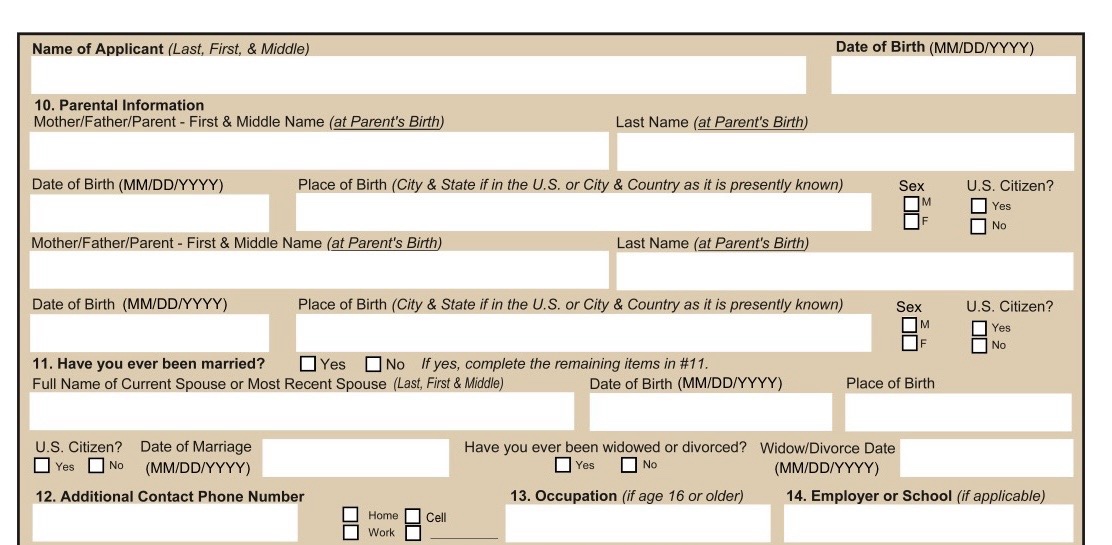
The Undeclared Field
The next field was: Occupation.
Oh! That is actually something I do remember about him. I can do this.
Do they ask later about my occupation? I do not see it. Strange.
They want his occupation and not mine? Whose occupation do they mean here? Mine or his?
This is clearly a design flaw. The form jumps from me to him and back to me? Where is their logical thinking? What kind of logic is this?
Wait, Katya, wait.
Surely they thought this form through. They probably hired capable people to design it.
What if they needed all the possible names I could have had through marriage first? That might be their processing priority. Of course!
I am reading the form by sections dedicated to individuals: me, my husband, my mother as a contact person. In this passport application they are trying to trace me through names and people.
Three Examples
Suppose we have a matrix.
1 2 3 4 5 6 7 8 9
And we want the sum. What sum? The sum of each row? Each column? The whole array? We need to define the organization we have in mind.
Or another one.
| John | 32 |
| Mary | 25 |
| Peter | 41 |
Let's sort. The task would require guessing our organizing principle. For that, one would need to ask a crystal ball a few questions. Alphabetically? By age?
And another one. The family in the apartment next to mine: Sue, Peter, Mary.
I just enclosed them in my mind behind their apartment door. Without enclosure they are just three strangers who could live in separate countries. Enclosing them might be useful.
I need to keep an eye on what my mind really does.
When I do not see the logic, I could try placing myself in the other person's position and see a different organizing principle. When my mind makes implicit assumptions, I might try to trace my own path of thinking.
I cannot remember the dates of my marriage or my divorce. But I can at least ask myself: What just happened in my mind when I saw the data? How did I organize it?
- [1]U.S. Department of State. Form DS-11, Application for a U.S. Passport. Items 10–14. Field document.
- [2]Iverson, K. E. (1962). A Programming Language. Wiley. §on axis specification in reduction.
- [3]Obituary of the former spouse. Consulted for one date, gratefully.
Author statement · The author retracts her charge of a design flaw and apologises to the capable people who designed the form. The dates of the marriage and the divorce remain unrecovered. The author declares no competing interests and one unspecified axis.
Conflicts of interest · The author declares no competing interests.
Funding · This work received no external funding, only tea.
Cite as · Solstad, K. (2026). Passport Form. Acta Observationum, I(1), pp. 71–74.