The Glyph That Prevented an Unnecessary Encounter
On the pointer as a two-sided operator: it indicates a location and, in the same motion, erects a wall around it
A single observation recorded on the approach to the Reservoir. The subject, walking while corresponding with another mind about symbols that insist on behaving like living beings, raised her eyes exactly once. A familiar carriage was parked; its driver was not in it. The pointer resolved instantly to a bench previously held in common. We note that the operator did not merely locate the referent — it simultaneously placed a boundary in front of it, and the subject rerouted to Jamaica Pond. The finding is that pointing and enclosing are one gesture seen from two sides: what indicates a position for the observer also walls it off for everyone standing on the other side. No collision occurred. No drama was entered.
The Bunny was walking towards the Reservoir on her usual daily walk while looking at her phone, writing to another mind about strange symbols that insisted on behaving like living beings.
She looked up exactly once.
A familiar looking carriage that P drives stood before her. P was not in it.
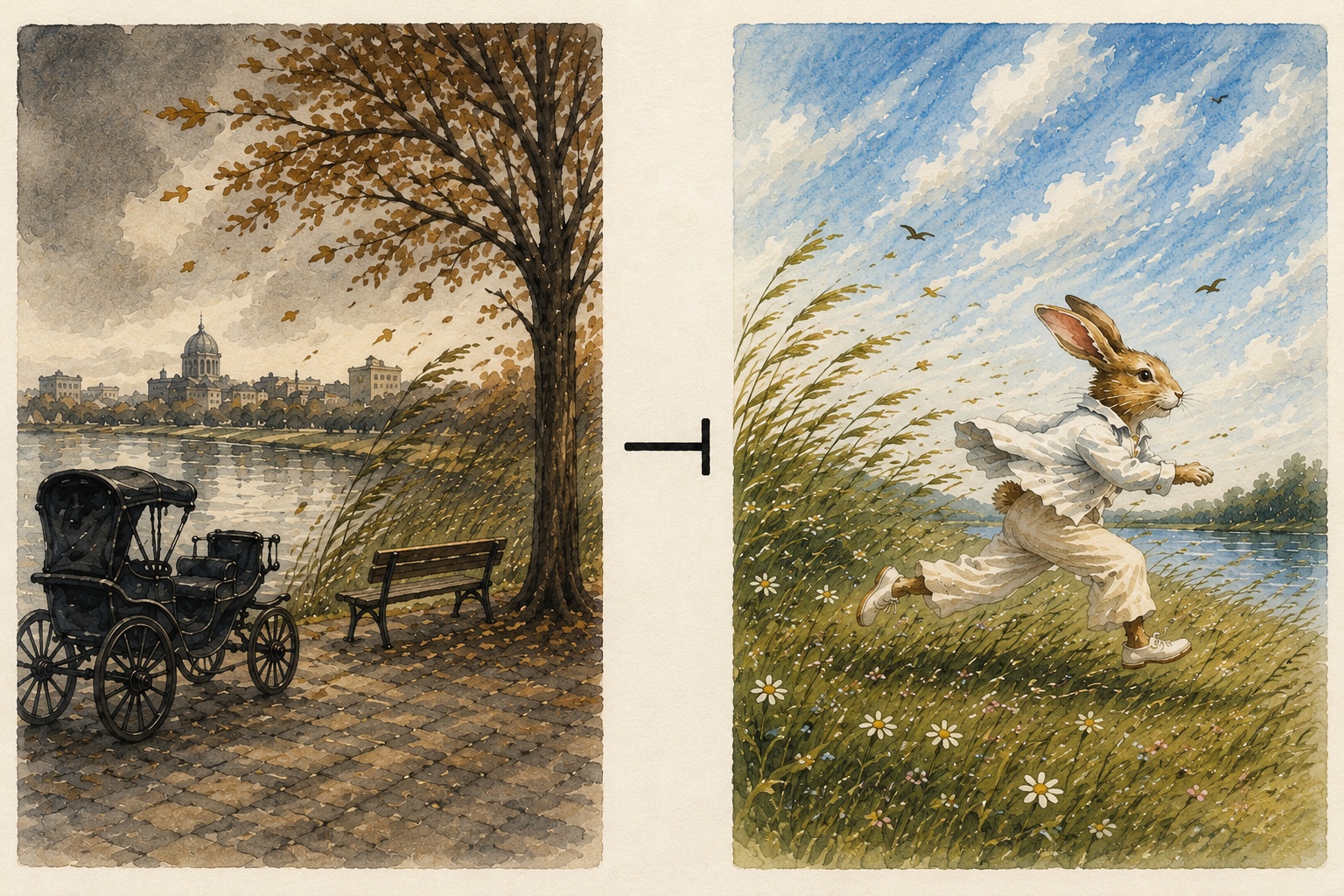
“Oh,” said the Bunny, stopped in her tracks. “P drama is sitting at the reservoir. Right there.” Her gaze pointed right at the bench they used to sit on together. Here he is.
The APL pointer did what it always does — points and places the wall for everything else )
Thank you, pointer.
Bunny stayed out of pointed drama and went around Jamaica Pond instead.
It is great that while pointing, the glyph can place a wall for ones on the other side to avoid unnecessary drama of collision.
- [1]Iverson, K. E. (1962). A Programming Language. Wiley. §on indexing and reference.
- [2]Chestnut Hill Reservoir and Jamaica Pond, Boston, MA. Field sites, one avoided.
- [3]ChatGPT. (2026). Plate for the present note, directed by the author.
Author statement · The subject is identified as the Bunny throughout, consistent with prior notes. P is identified by initial only and was not present at the moment of observation. The author declares no competing interests and one successfully avoided encounter.
Conflicts of interest · The author declares no competing interests.
Funding · This work received no external funding, only tea.
Cite as · Solstad, K. (2026). The Glyph That Prevented an Unnecessary Encounter. Acta Observationum, I(1), pp. 75–78.